Water Damage Restoration vs. Mitigation: NRH Homeowners Guide
When water enters a North Richland Hills home, most homeowners want to know one thing: how long until the house is back to normal? The honest answer is that the process has two distinct phases — mitigation and restoration — and understanding the difference between them helps set realistic expectations for timeline, costs, and insurance billing.
In this post, we explain what mitigation covers, what restoration covers, why both phases are necessary, and how they sequence on a typical NRH water damage project.
Water Damage in North Richland Hills? We Handle Both Phases.
Call (877) 698-1311 for mitigation and full reconstruction under one company.
Mitigation: Stopping the Damage From Getting Worse
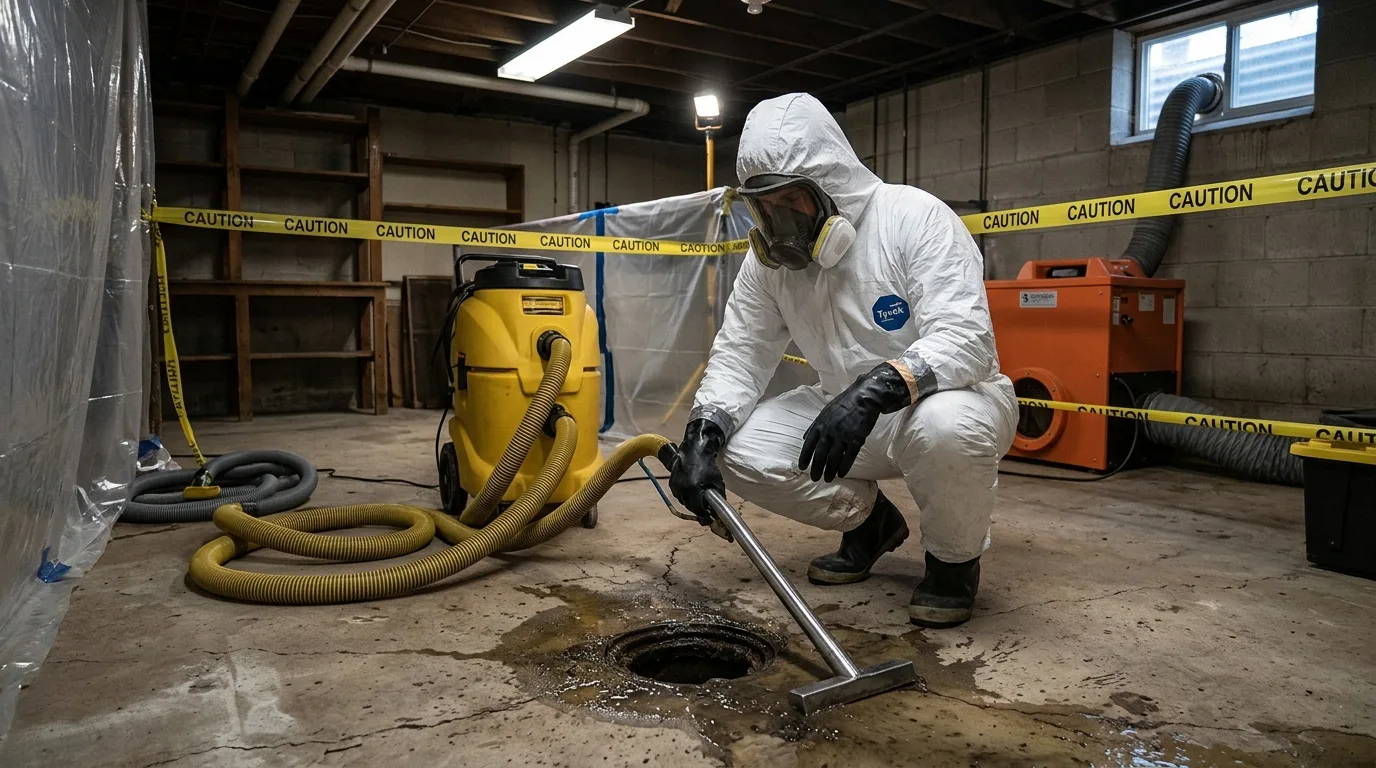
Water damage mitigation is everything that happens from the moment our team arrives to the point where the structure is dried and stable. Mitigation is time-sensitive — its entire purpose is to prevent the damage from expanding beyond what has already occurred.
Mitigation for a North Richland Hills water event typically includes:
Emergency water extraction: Truck-mounted and portable extractors remove standing water from all accessible surfaces. For significant flood events in neighborhoods like HomeTown or Fossil Creek, this phase alone can take 2–6 hours.
Moisture mapping: Thermal imaging cameras and penetrating moisture meters document where water has migrated inside walls, under floors, and into ceiling assemblies. This map drives every subsequent decision.
Structural material removal: Wet drywall below a certain height, water-saturated insulation, soaked flooring, and contaminated materials are removed to allow the structural assemblies behind them to dry. This step is not destruction — it is controlled access for drying equipment.
Structural drying: Industrial air movers and dehumidifiers are placed at calculated positions and run continuously, with daily monitoring until all materials reach IICRC-established moisture content goals.
Antimicrobial treatment: For Category 2 and Category 3 water events, antimicrobial treatments are applied to all affected surfaces after extraction.
Verification and documentation: Daily moisture logs and a final drying report document that drying goals were achieved. This paperwork becomes part of your insurance file.
Restoration: Returning the Home to Pre-Loss Condition
Restoration begins only after mitigation is complete and verified. This is the reconstruction phase — putting everything back. Restoration includes:
Drywall installation and finishing: New drywall is hung, taped, floated, and textured to match existing finishes. For North Richland Hills homes with custom textures, matching the original finish is part of the scope.
Insulation replacement: New insulation replaces removed insulation at matching R-values and with appropriate vapor barriers for Tarrant County’s climate conditions.
Flooring installation: Replacement of removed flooring in matching materials, including subfloor repair if structural layers were affected.
Paint and finish work: Painting affected rooms to match existing colors and finishes.
Cabinet and trim reinstallation: Any cabinetry or trim removed for drying access is reinstalled or replaced if damaged.
Plumbing and electrical: Any trade work required to address the original water source or damaged systems, including permits from the North Richland Hills Building Inspection Department where required.
Why the Sequence Matters
The order — mitigation first, restoration second — is not arbitrary. Beginning reconstruction before verified drying means sealing moisture inside wall cavities where it will support mold growth and material deterioration. This is the single most common mistake made when homeowners or unqualified contractors rush the process.
In North Richland Hills’s humid climate, where ambient moisture is elevated especially in summer, unsealed moisture in a closed wall cavity can develop visible mold growth in as little as 5–7 days. Reconstruction built over that mold must be torn out and redone — at the homeowner’s expense if the premature closure voided the warranty or insurance coverage. Our protocol is unambiguous: we do not begin reconstruction until moisture verification confirms all materials are within IICRC drying targets.
How Insurance Covers Each Phase
Most homeowner’s insurance policies process mitigation and restoration as separate claim items. Mitigation is typically covered under the dwelling damage portion as emergency protective measures. Restoration is the property repair claim. Some insurance carriers have preferred vendor lists or scope limits — we work with all major carriers and provide the documentation each carrier’s claims process requires.
It is important to understand that insurance coverage for mitigation should not be delayed waiting for adjuster approval. Most policies allow the insured to begin emergency mitigation immediately to prevent further damage, with the carrier reimbursing covered costs. Our documentation process creates the evidence trail required for reimbursement.
North Richland Hills Water Damage — Full Service Restoration
Mitigation and reconstruction under one team. Call (877) 698-1311 any time.
Practical Uses of Understanding These Phases
When getting multiple estimates: Compare mitigation and reconstruction estimates separately. Some contractors quote only mitigation; others quote only reconstruction. A single-company estimate covering both phases is typically more cost-effective and eliminates coordination gaps.
When talking to your adjuster: Understanding the phase terminology helps you communicate accurately with your adjuster. “Mitigation is complete and we’re ready for reconstruction” is a precise, actionable statement that advances the claim. Vague descriptions cause delays.
When evaluating timeline: Mitigation typically takes 5–10 days for a moderate event. Reconstruction scheduling adds 1–4 weeks depending on trade contractor availability in Tarrant County. Total project timeline for a significant water damage event in North Richland Hills is typically 3–6 weeks from first truck to move-back.
When choosing a contractor: A contractor who can handle both phases under one management team reduces coordination failures and timeline gaps. Separate mitigation and reconstruction contractors must hand off documentation, agree on scope, and coordinate scheduling — a process that adds risk and time.
Cost Summary for North Richland Hills
Mitigation in North Richland Hills runs $1,200–$9,000+ depending on scope and water category. Reconstruction ranges from $1,500 for minor drywall repair to $20,000+ for multi-room full rebuilds. For a typical moderate event — one to two affected rooms, clean water, caught within 24 hours — total project cost runs $4,000–$8,000. See our full pricing breakdown in the 2026 water damage restoration cost guide for North Richland Hills.
Frequently Asked Questions
Can I start cleaning up myself before the mitigation company arrives?
Removing salvageable belongings and non-contaminated furniture from wet areas is acceptable and reduces disposal costs. Do not attempt to remove soaked drywall, damaged flooring, or structural materials without professional guidance — incorrect removal can introduce contamination spread or compromise structural integrity. Do not use household fans or dehumidifiers in place of calling for professional mitigation — the equipment differential is not compensable.
How do I know when mitigation is complete in North Richland Hills?
Mitigation is complete when a certified technician confirms via written moisture readings at multiple measurement points that all affected materials have reached IICRC-specified moisture content goals. This is a documented, measurable outcome — not a visual or tactile assessment. We provide written drying reports at mitigation completion as standard practice.
Does my insurance company prefer certain water damage restoration companies in NRH?
Some insurance carriers have preferred vendor programs, but you generally have the right to choose your own restoration contractor. Preferred vendor status sometimes creates conflicts of interest — vendors who depend on carrier referrals may be incentivized to minimize documented scope. We work directly with all carriers including State Farm, Allstate, USAA, Travelers, and others, and provide complete documentation regardless of the carrier relationship.
Full-Service Water Damage Restoration in North Richland Hills
From the first extraction to the final coat of paint. Call (877) 698-1311.
Related: