5 Hidden Signs of Water Damage in Your NRH Home
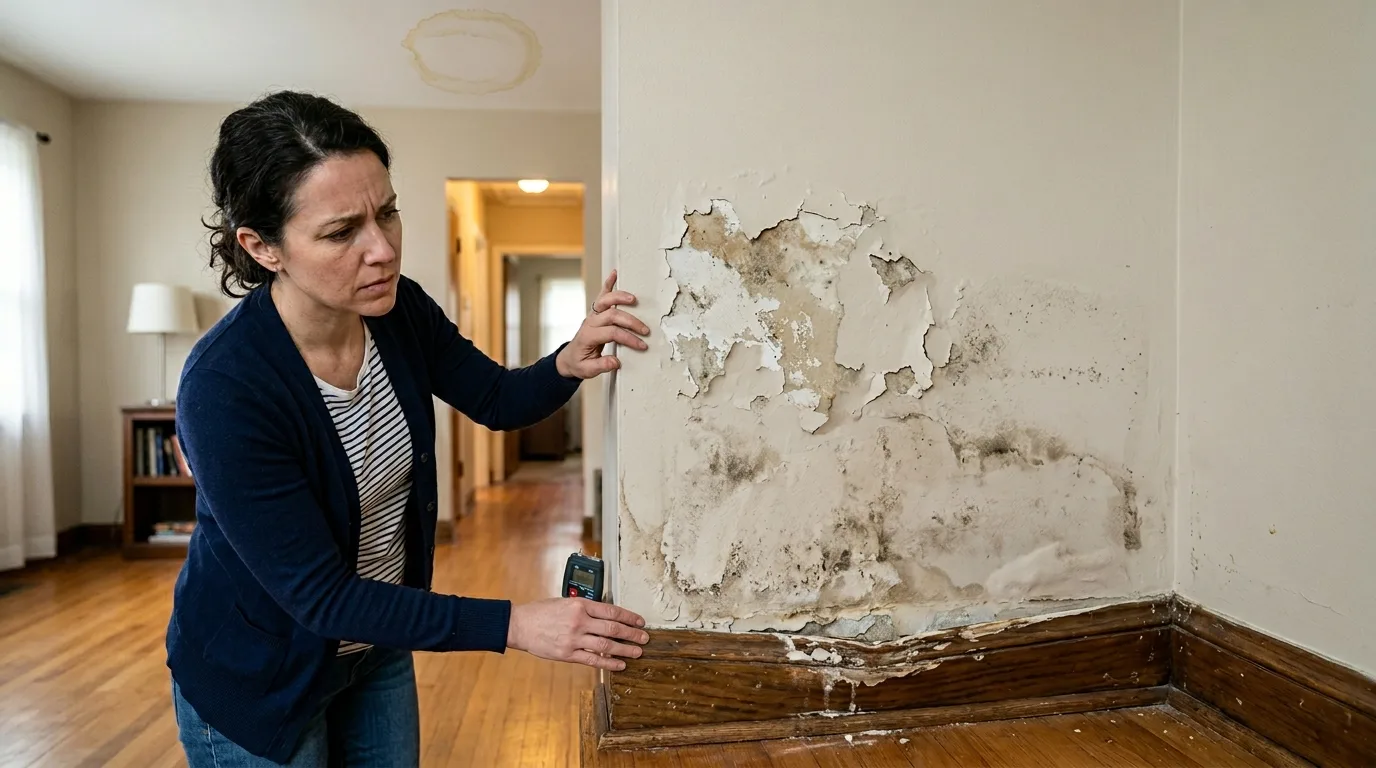
The most expensive water damage in North Richland Hills is rarely from events homeowners saw coming. It’s the slow kitchen sink supply line drip that’s been wetting the cabinet base for six months. The attic pipe that leaked just enough after each rain to keep the insulation damp without ever producing a ceiling stain. The crawl space moisture that’s been feeding mold under the floor for two years.
These hidden events are often caught only when the damage has reached a scale that requires major reconstruction. In this post, we cover the five most commonly missed water damage warning signs for NRH homeowners — signals that a problem is developing before it becomes a crisis.
Suspect Hidden Water Damage in North Richland Hills?
Call (877) 698-1311 for professional moisture detection and assessment.
Why Hidden Water Damage Is Common in North Richland Hills
Tarrant County’s highly expansive clay soil creates a baseline moisture environment around foundations that masks early moisture intrusion signals. Small amounts of moisture at the foundation level can go undetected by homeowners for extended periods because the clay soil itself is always moving between wet and dry states — a slight increase in foundation moisture doesn’t always trigger visible changes immediately.
NRH’s hot, humid summers also mean that condensation on cool surfaces (cold water pipes, AC ducts) is a normal occurrence. When that condensation happens inside walls or in unconditioned spaces, it can accumulate over time without any single dramatic event. The Smithfield and HomeTown districts have many homes with HVAC systems running through unconditioned attics — a configuration that creates persistent condensation risk during Texas summers.
Sign 1: Musty or Earthy Odor Without a Visible Source
A persistent musty or earthy smell — especially concentrated in certain rooms, around specific walls, or in the basement or lower level — is often the first detectable indicator of active mold growth. Mold produces microbial volatile organic compounds (mVOCs) that create a distinctive odor before visible growth is apparent.
In North Richland Hills homes, this odor commonly develops in bathrooms with slow exhaust fan ventilation, in laundry rooms with appliance supply line drips, and in crawl spaces after heavy spring rains saturate the clay soil beneath the home. If the smell appears after a wet season, intensifies during humid weather, or is strongest near exterior walls, it warrants professional moisture detection rather than air freshener treatment.
Sign 2: Staining or Discoloration Below Visible Watermarks
Water stains on ceilings and walls are well known. The hidden version is discoloration that appears below or around finished surfaces: yellow or brownish staining at the base of walls near windows, discoloration where trim meets flooring, or dark streaks on the back side of cabinet interiors. These lower-position stains are caused by slow migration — water moves by capillary action through porous materials away from the source, often appearing far from where the leak originates.
Cabinets near the kitchen sink or dishwasher deserve specific attention. Check the cabinet floor and the back panel at least twice per year. Warped, soft, or discolored cabinet floors are almost always the result of a slow supply or drain line drip that has been developing for months. In North Richland Hills’s climate, these slow leaks rarely dry out between events — the ambient humidity prevents the wood from returning to normal between drips.
Hidden Moisture in Your NRH Home? We Use Thermal Imaging.
Non-invasive moisture detection. Call (877) 698-1311.
Sign 3: Buckling, Cupping, or Gapping Hardwood Floors
Hardwood floors respond to moisture before drywall or painted surfaces show any sign. Cupping — where the edges of each board are higher than the center — indicates moisture is entering from below, wetting the bottom face of the boards more than the top. Buckling, where sections of floor have lifted off the subfloor, indicates more significant and sustained moisture intrusion.
Gapping between boards during winter (when heating systems lower indoor humidity) is normal seasonal movement. Gapping that doesn’t close when humidity returns in spring, or that appeared during a wet period rather than a dry period, indicates the floor has been pushed apart by moisture and did not return to its original position — a sign that the subfloor beneath is wet.
In the Iron Horse neighborhood and throughout NRH’s slab-on-grade homes, subfloor moisture that causes hardwood cupping often originates from slab moisture vapor — Tarrant County’s clay soil releasing moisture through the slab over time. This is a chronic condition in some older homes that requires vapor barrier solutions rather than just surface drying.
Sign 4: Peeling Paint or Wallpaper Near Exterior Walls or Windows
Paint and wallpaper adhesion fail when moisture vapor migrates through a surface. Peeling paint on exterior walls — particularly on north-facing walls that receive less sun and stay cooler — indicates moisture vapor is migrating from outside to inside, often through gaps in the building envelope. Window frame areas are common failure points because the junction between frame and wall is a frequent moisture pathway.
This peeling pattern is different from old paint that simply needs repainting. The diagnostic sign is that the peeling is localized to areas adjacent to exterior materials, appears after wet weather cycles, and is often accompanied by slight dampness when you press on the wall surface. In North Richland Hills homes built before the 2000s, caulk around windows and exterior trim has often dried and cracked, creating these vapor pathways.
Sign 5: Unexplained Increase in Water Bill
A water bill that is 20% or more higher than the same period in prior years without a corresponding lifestyle change often indicates a hidden plumbing leak. A supply line dripping 1 gallon per hour uses 720 gallons per month — enough to produce a noticeable bill increase and enough water to continuously wet structural materials.
For North Richland Hills homeowners, a spike in the June–August water bill (when outdoor watering makes comparisons difficult) can be hard to attribute. Check the water meter: turn off all fixtures and observe whether the dial is moving. If the meter moves with all fixtures off, you have an active leak. The meter test takes 5 minutes and can identify a problem that would otherwise produce thousands in water damage over the next year.
Cost Factors for Early vs. Late Detection
Early detection of hidden water damage is one of the highest-value maintenance investments available to NRH homeowners. Water damage discovered within the first month of onset costs $1,200–$3,500 for typical residential events. The same event discovered after 3–6 months of slow development typically costs $5,000–$15,000 because structural materials have been continuously wet, mold has established, and the affected area has expanded. Across Tarrant County, early detection investment — annual inspections, moisture meter checks, water bill monitoring — pays for itself in avoided restoration costs.
See our full cost guide for detailed restoration cost ranges in North Richland Hills.
Frequently Asked Questions
Can I detect hidden water damage without professional equipment?
You can detect some signs — odors, visual staining, floor behavior, cabinet condition — with no equipment. However, moisture inside wall cavities and under flooring typically requires a penetrating moisture meter or thermal imaging camera to identify. Our inspection includes both tools and can locate moisture inside closed assemblies without destructive opening.
How often should I inspect for hidden water damage in North Richland Hills?
Twice per year — once before spring storm season (February) and once in early fall (September) after the summer humidity peak. Additional checks are warranted after any significant water event, after hail storms (roof leaks), and after extended dry periods (which can crack foundation seals in Tarrant County’s clay soil, creating new intrusion pathways). Learn more about mold prevention after water leaks in NRH.
What does professional moisture detection cost in North Richland Hills?
Professional moisture inspection in North Richland Hills typically costs $150–$350 for a thorough whole-home assessment using thermal imaging and penetrating moisture meters. For perspective, this investment can identify a problem that — if found two years later — would cost $10,000–$20,000 to remediate. We include moisture assessment as part of every water damage consultation.
Professional Moisture Detection in North Richland Hills
Thermal imaging and non-invasive moisture mapping. Call (877) 698-1311.
Related: